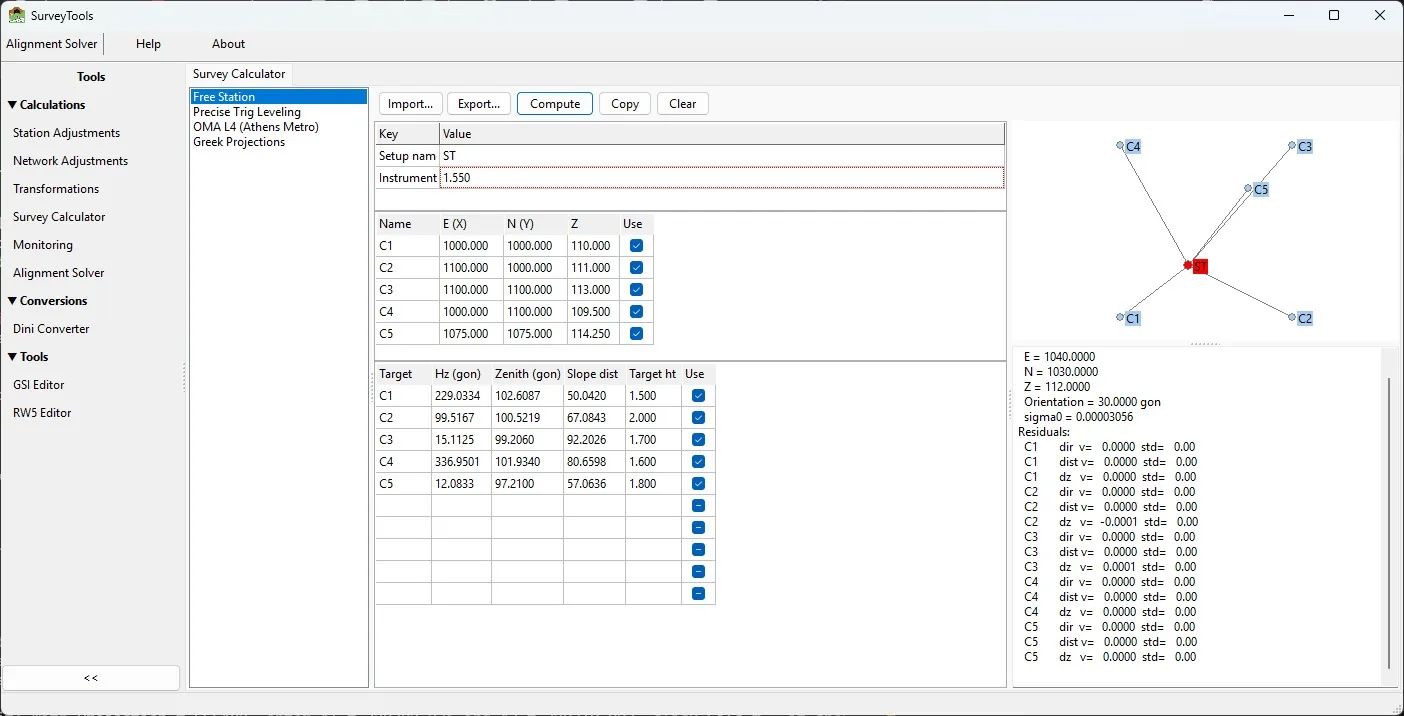
Knowledge base · Survey calculator
Compute a free station
Solve the instrument position and the circle orientation from angles and distances to known points.
Open Calculations > Survey Calculator > Free Station.
The solution is a least-squares resection. You do not type approximate coordinates. With more than the minimum observations you also get a standard error of unit weight and a residual on every observation.
What to type
Setup name defaults to ST. Instrument height is the height of the instrument above the mark, in metres.
Known points, one row each: name, E (X), N (Y), Z, and Use.
Observations, one row each: target, horizontal angle in gon, zenith angle in gon, slope distance, target height, and Use.
- A zenith of 100 gon is a level sight. This calculator has no DMS input.
- Use drops a row from the solution without deleting it.
- Every target name has to match a known point. The match ignores case. If it does not, Compute stops with a message.
- The minimum is 2 known points and 1 observation. More observations give a residual you can judge.
- A decimal comma and a decimal point are both accepted.
Click Compute.
The panel reports E, N, Z, the orientation of the horizontal circle in gon, and sigma0. Residuals are tagged dir (direction), dist (horizontal distance) or dz (height difference). Observations are weighted equally, so treat sigma0 as a comparison between solves, not as a unit-consistent standard error.
Solve failed (status N) means: 1 insufficient data, 2 divergent, 3 singular, 5 too many iterations.
The sketch draws the control in blue, the solved station in red, and the sight lines. Scroll to zoom. Drag to pan.
A file instead of the grid
Import… and Export… use a tagged CSV. A # line is a comment. Comma or tab both work. Import replaces the job.
# Free Station data
SETUP,ST,1.550
PT,C1,1000.000,1000.000,110.000,1
OBS,C1,229.0334,102.6087,50.0420,1.500,1
SETUP is the name and the instrument height. PT is name, E, N, Z, and an optional use flag. OBS is target, Hz, zenith, slope distance, target height, and an optional use flag. The use flag defaults to 1.