2.6.3. Precise Trig Leveling Calculator
2.6.3.1. Overview
The Precise Trig Leveling calculator computes height differences from reciprocal (simultaneous) trigonometric leveling: each line is observed from both ends — forward (From → To) and reverse (To → From). Averaging the two one-way results cancels the earth-curvature and atmospheric-refraction error, so no refraction coefficient has to be assumed. The discrepancy between the two directions is reported, along with the refraction coefficient k it implies — a powerful quality check for every line.
The tool is found under Calculations > Survey Calculator > Precise Trig Leveling.
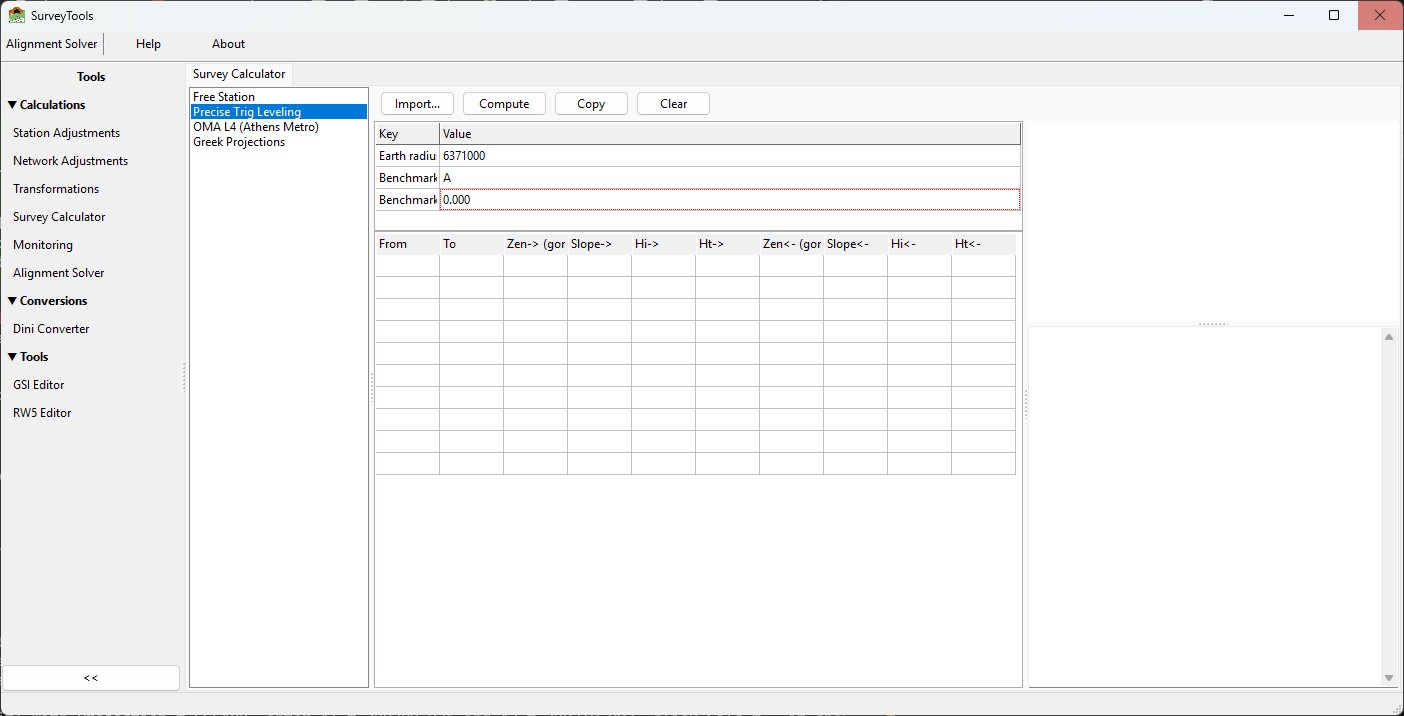
The Precise Trig Leveling calculator.
2.6.3.2. Inputs
Parameters (top editor):
Key |
Default |
Meaning |
|---|---|---|
Earth radius (m) |
|
Used only for the implied-k diagnostic; the mean height difference does not depend on it. |
Benchmark point |
|
Optional: a point name whose height is known. Leave blank to skip height propagation. |
Benchmark height |
|
The benchmark’s height (m). |
Reciprocal pairs grid — one row per leveling line, ten columns:
From | To | Zen-> (gon) | Slope-> | Hi-> | Ht-> | Zen<- (gon) | Slope<- | Hi<- | Ht<-
->columns are the forward observation (instrument at From, target at To): zenith angle (gon), slope distance (m), instrument height, target height.<-columns are the reverse observation (instrument at To, target at From) — usually a different instrument/target setup on the same line.Zenith angles are in gon; 100 gon = level sight.
A row is used when both
FromandToare filled.
2.6.3.3. Mathematics
For each direction the raw one-way vertical component is
dh = Slope * cos(zenith) + Hi - Ht
Curvature and refraction would add d²·(1−k)/(2R) to each one-way
value (d = horizontal distance) — but because the error is (nearly) the
same in both directions, the reciprocal mean cancels it:
mean dH     = ( dh_forward − dh_reverse ) / 2      = H(To) − H(From)
discrepancy =   dh_forward + dh_reverse            ≈ −2 · curvature/refraction term
implied k   =   1 + R · discrepancy / d²           (diagnostic only)
A discrepancy near zero means the pair was well balanced
(near-simultaneous, comparable refraction, similar distances). A large
value flags a bad reading or unbalanced conditions on that line.
If a Benchmark point is given, heights are propagated from it
through the chain of computed lines (each pair is a bidirectional link
worth mean dH), and the derived height of every reachable point is
reported. The benchmark name must match a From/To name in the grid.
2.6.3.4. Results
One block per pair:
A -> B
  mean dH   = 6.3419
  fwd dH    = 6.4482
  rev dH    = -6.2357
  discrep   = 0.2125
  implied k = 0.303
  H(B)      = 106.3419
mean dH is H(To) − H(From): positive means To is higher. The
sketch pane draws the first pair’s geometry (From at the origin, To at
its horizontal distance and mean height difference).
2.6.3.5. Import
Import… reads a plain CSV/semicolon/tab file, one pair per line, no header, exactly this field order:
From,To,ZenF,SlopeF,HiF,HtF,ZenR,SlopeR,HiR,HtR
A,B,99.5244,850.0237,1.600,1.500,100.4868,850.0248,1.550,1.600
Lines with fewer than ten fields are skipped. Imported rows are
appended to the grid (existing rows are kept). A sample file is
installed as testfiles/surveycalculator/ptl_pairs.csv. Use Copy
to place the results on the clipboard; there is no file export in this
calculator.
2.6.3.6. Notes
The refraction coefficient is never an input: the reciprocal method eliminates it from the mean.
implied kmerely tells you what refraction was in effect — typical values are around 0.13; values far outside ~0–0.3 deserve suspicion.Changing the Earth radius affects only
implied k.Hi/Htmust be the actual heights of the instrument and target for that direction’s setup — they generally differ between the forward and reverse observations.